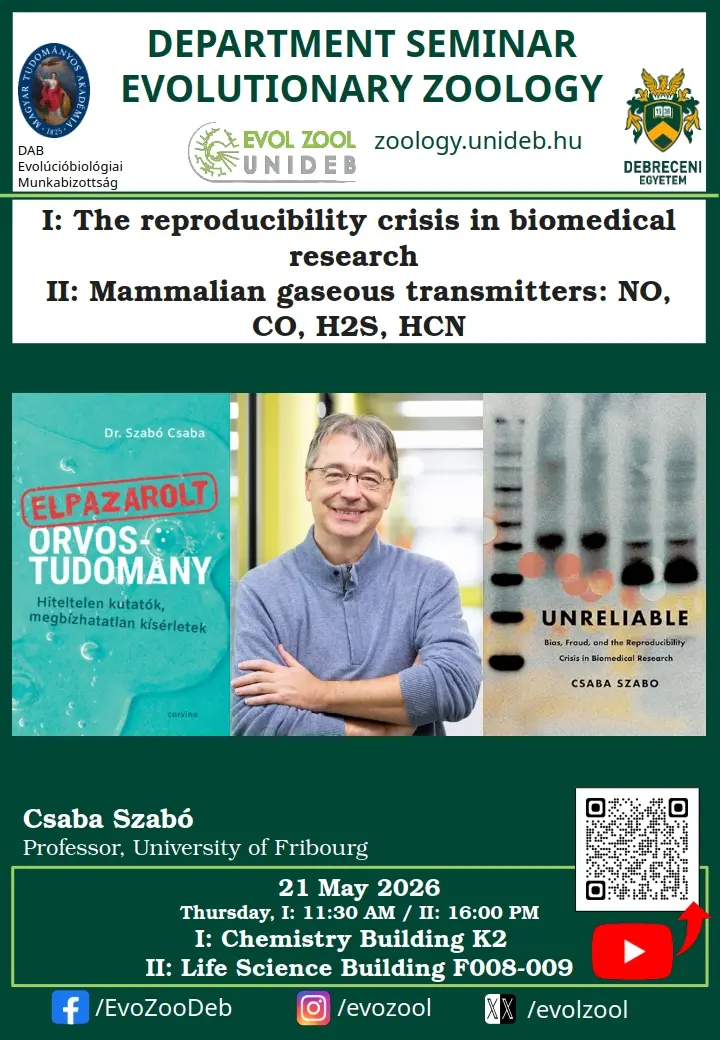
 We are glad to invite you to the upcoming scientific seminars of the Department of Evolutionary Zoology and Human Biology, University of Debrecen.
Thursday 21 May 2026
The reproducibility crisis in biomedical research
11:30 K/2 lecture room, Chemistry Building
The presentation examines the current state of the reproducibility crisis in scientific research and its underlying causes. A large proportion of published biomedical studies cannot be independently replicated due to methodological issues, publication pressure, inadequate training, and even deliberate fraud. The misuse of artificial intelligence is further worsening the problem. Minor reforms are insufficient, and substantial changes are needed in funding systems, research training, and publication practices. The proposed solutions aim to improve scientific reliability, reduce wasted resources, and rebuild public trust in biomedical research.
Mammalian gaseous transmitters: NO, CO, H2S, HCN
16:00 F008-009 lecture room, Life Sciences Building
The presentation explores the role of gaseous signaling molecules in mammalian physiology. Nitric oxide (NO), carbon monoxide (CO), hydrogen sulfide (H₂S), and cyanide (CN⁻) are now recognized not only as toxic substances but also as important endogenous signaling mediators. These gasotransmitters regulate processes such as vascular function, neurotransmission, inflammation, and cellular energy metabolism. Although they differ in their biosynthesis and molecular targets, they share common effects on mitochondrial function and redox homeostasis. Understanding their biology may open new therapeutic opportunities for cardiovascular, neurological, and inflammatory diseases.
Csaba Szabó M.D., Ph.D., D.Sci., FBPS, MAE
Professor of Pharmacology
President of the Department of Oncology, Microbiology and Immunology
University of Fribourg, Switzerland
Professor Csaba Szabó is an internationally recognized expert in oxidative and nitrosative stress, gaseous transmitters, cell death, cardiovascular dysfunction, and inflammatory mechanisms. Over the past decade, much of his research has focused on the biology of the endogenous gaseous mediator hydrogen sulfide (H₂S), where he identified novel roles in circulatory shock, reperfusion injury, angiogenesis, cancer, and Down syndrome. This work has inspired new therapeutic strategies based on both H₂S donation and inhibition of H₂S biosynthesis. More recently, he pioneered a new field investigating the biological regulatory roles of cyanide in mammalian cells and tissues. Trained as an M.D./Ph.D. in Budapest, Hungary, he completed his postdoctoral fellowship under Nobel Laureate Sir John Vane at the William Harvey Research Institute in London in the early 1990s. From 1994 to 2018, he served as a professor of Pharmacology, Experimental Surgery, and Anesthesiology in the United States, where he founded and led multiple academic and biotechnology research groups in Ohio, Massachusetts, New Jersey, Washington, and Texas. In 2018, he returned to Europe, where he is currently Chair of the Section of Pharmacology and Director of the Department of Oncology, Microbiology, and Immunology at the University of Fribourg, Switzerland. In parallel with his academic leadership, Professor Szabo has held senior scientific positions in biotech companies working on nitric oxide, hydrogen sulfide, and poly(ADP-ribose) polymerase, advancing several drugs to clinical development and contributing to IPOs and major industry transactions. He has published extensively, with an H-index of 155 and over 95,000 citations, which ranks him one of the most cited biomedical scientists in the field of experimental biology. Professor Szabó has received numerous awards, including the Novartis Award of the British Pharmacological Society, the Dennis Gabor Innovation Award, the Texas Star Award, the Pharmacia-ASPET Award for Experimental Therapeutics, and the John Vane Medal. He serves on the editorial boards of leading journals and is an elected Fellow of the British Pharmacological Society, the American Society for Clinical Investigation, and Academia Europaea.
The talks will be delivered in English and can be viewed live at the following link: